Every year, I meet parents who ask me the same question during dismissal or after class: “Teacher Suzanne, my child could spell all the words yesterday, but today they’ve forgotten almost everything. Is this normal?” My answer is always reassuring: yes, it is more common than you think.
As a Kindergarten 2 teacher, I have worked with many children preparing for Primary 1, and I have found that this challenge is rarely caused by poor memory or a lack of effort. Instead, it often stems from the way children are taught to learn spelling. Many young learners are encouraged to memorise words repeatedly until they can reproduce them for a spelling test.
While this may produce short-term success, it does not equip them with the skills needed to read, spell and write independently. At Writers Studio, we believe that literacy is not about memorising lists of words. It is about helping children understand how the English language works, so they develop the confidence to tackle unfamiliar words long after they leave our classrooms.
Why Memorising Alone Isn’t Enough
Think back to how spelling was taught years ago. Many of us were asked to write each spelling word ten or twenty times until we could remember it. While this repetitive practice can improve short-term recall, educational research has shown that memorisation alone does not produce lasting learning. Cognitive psychologist George A. Miller, whose research on human memory introduced the concept of “chunking”, found that the brain processes information far more efficiently when it is organised into meaningful units instead of isolated pieces.
Rather than remembering eight unrelated letters, the brain naturally looks for patterns that reduce the amount of information it needs to process. Educational psychologist David Ausubel also emphasised that meaningful learning occurs when children connect new knowledge to existing understanding instead of relying solely on repetition.
In simple terms, children remember much more when they understand why something works, not just what it looks like. This explains why many children can score perfectly for a spelling test on Friday but struggle to recognise the very same words while reading a storybook the following week. They have memorised the letters, but they have not understood the structure of the word.
Reading and Spelling Are Two Sides of the Same Coin
Many parents whom I met think reading and spelling are separate skills that should be taught independently. In reality, they develop together. Research from the National Institute of Child Health and Human Development (NICHD) has consistently shown that proficient readers are able to recognise sound patterns, syllables and common spelling structures automatically. Instead of trying to remember every word individually, they learn to decode unfamiliar words by recognising familiar parts within them. This is why children who become confident readers often become strong spellers as well. When children understand how English words are constructed, they no longer depend entirely on memory. Instead, they begin solving words like puzzles, using patterns they have already learnt to unlock new vocabulary. This ability becomes increasingly important in Primary 1, where children encounter much longer reading passages, richer vocabulary and more complex writing tasks.
The Syllable Method: Helping Children Understand Words
One of the most effective strategies I teach in my K2 classroom is the syllable method. A syllable is a unit of sound within a word. Instead of expecting children to memorise a long word as one large block of letters, we teach them to break it into smaller, manageable parts.
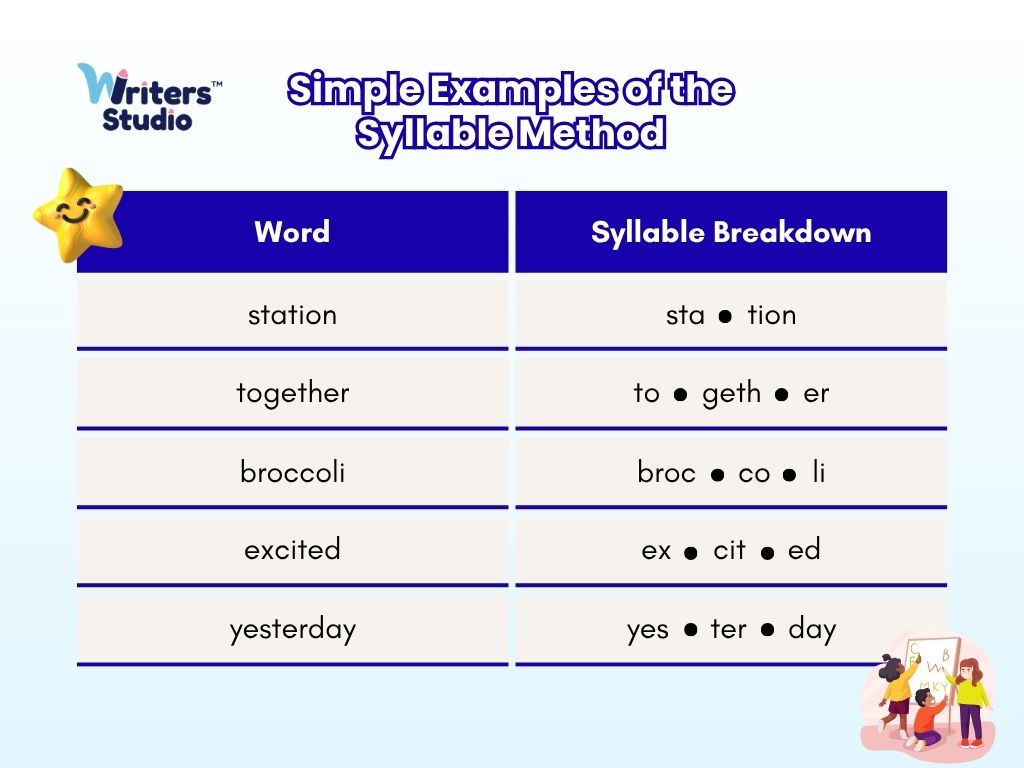
For example, rather than seeing the word “excited”, children learn to read it as ex | cit | ed. Instead of feeling overwhelmed by “broccoli”, they learn to recognise broc | co | li.
Even longer words such as “yesterday” become much easier when children break them into yes | ter | day. Once children realise that long words are simply made up of smaller pieces, they become much more willing to attempt unfamiliar vocabulary. The fear of difficult words gradually disappears because they have a strategy they can rely on.
Why Breaking Words into Syllables Works
The syllable method works because it aligns with the way our brains naturally process language. Rather than trying to remember every individual letter, children group letters together into meaningful sound units. This reduces the mental effort required to decode a word while improving both pronunciation and spelling. More importantly, children begin recognising recurring spelling patterns. For example, after learning the word station, they quickly notice that the ending “tion” also appears in words such as vacation, education, celebration and invitation.
Suddenly, they are no longer learning one isolated word at a time. They are learning how English words are built. This pattern recognition is one of the key differences between children who rely on memorisation and children who become independent readers. As their vocabulary grows, these patterns become increasingly valuable because they allow children to decode words they have never encountered before.
Preparing Children for Primary 1 Starts Earlier Than Most Parents Think
One of the biggest misconceptions I encounter is that children only need to begin preparing for Primary 1 once Kindergarten is almost over. In reality, the foundations for Primary 1 English are built throughout the preschool years. Primary school requires children to process larger amounts of information independently. Reading passages become longer, comprehension questions require deeper thinking, and writing tasks demand a wider vocabulary. Children who have only memorised words often become overwhelmed because they are faced with unfamiliar vocabulary every day.
However, children who understand syllables, sound patterns and word structures approach these new challenges very differently. Instead of giving up when they see an unfamiliar word, they slow down, break it apart and apply the decoding strategies they have learnt. This confidence transforms not only their reading, but also their willingness to participate in class discussions, attempt new books and express themselves through writing.
It’s About Building Confidence, Not Just Better Spelling
Perhaps the greatest reward of teaching children through understanding rather than memorisation is the confidence they develop. One of my favourite moments as a teacher is watching a student successfully read a difficult word they have never seen before. They often look up with excitement and say, “Teacher, I did it!” That moment is about much more than reading one word correctly. It represents the child’s growing belief that they are capable of learning independently.
Confident children become more willing to ask questions, read more challenging books and experiment with new vocabulary in their writing. Over time, these habits create stronger readers, more expressive writers and more confident communicators. These are skills that cannot be developed through memorisation alone.
How We Teach Literacy at Writers Studio
At Writers Studio’s Twinkle Stars Programme, we believe that literacy should be taught systematically, meaningfully and joyfully. While phonics provides an important foundation, we extend learning beyond letter sounds by helping children understand vocabulary, sentence construction, oral communication and early writing. The syllable method is one of the many research-informed strategies we use to strengthen reading fluency and spelling confidence.
Every lesson is carefully designed to encourage children to think about words, identify patterns and apply their knowledge independently. Instead of teaching children what to memorise, we teach them how to learn. This difference is what prepares our students not only for Primary 1 English, but for lifelong success as readers and writers.
Final Thoughts
If your child regularly forgets spelling words, struggles with longer vocabulary or guesses unfamiliar words while reading, it does not necessarily mean they need to spend more time memorising. It may simply mean they have not yet been given the right strategy. Research consistently shows that meaningful learning occurs when children recognise patterns, understand concepts and actively apply what they know.
By teaching children to decode words through syllables and understand the building blocks of English, we are giving them far more than better spelling scores. We are equipping them with the confidence to become independent learners who can tackle new challenges with curiosity rather than fear. As teachers, that is the greatest gift we can give our students. Not simply the ability to remember words for tomorrow’s test, but the skills to continue learning for years to come.
About Teacher Suzanne
Teacher Suzanne is an English teacher at Writers Studio’s Twinkle Stars Programme, where she teaches K2 pupils in reading, spelling, oral and early writing. With years of experience preparing children for the transition to Primary 1, she believes that literacy is built through understanding rather than memorisation. Her lessons combine evidence-based teaching strategies with engaging classroom activities to help young learners get ready for elementary learning.