

04 February 2026
Why Students Rush and Make Careless Mistakes and How to Help Them Manage It
Many students understand their work but still lose marks to careless mistakes. This is one of the most common challenges you may notice in Primary school English, especially as academic demands increase.
You may find yourself saying, “My child knows the answer, but keeps making small mistakes.” If this sounds familiar, you are not alone. This pattern is very common and does not mean your child is lazy, careless, or lacking ability.
When your child works under pressure, their mind is juggling many things at once. Understanding the question, recalling what they have learnt, forming sentences, and writing them down. At this age, the ability to monitor accuracy is still developing. When thinking load increases, small slips naturally happen.
It can be frustrating for you as a parent, especially when you know your child is capable. However, these mistakes are not signs of failure. They show that your child is learning to balance speed, accuracy, and control and this is a skill that takes time and guidance to build.
With the right support and structured practice, this balance improves. Careless mistakes reduce not because your child is told to “be more careful”, but because they are taught how to slow down, check their thinking, and work more deliberately.
Why Carelessness Is Common in Children
Children’s thinking systems are still developing. When they work on a task, they are often managing several things at once:
-
- understanding the question
-
- thinking of ideas
-
- recalling rules
-
- writing neatly and quickly
Because their attention capacity is limited, accuracy is usually the first thing to suffer when they rush.
In a child’s mind, the priority is often finishing the task, not refining it. This is why careless mistakes happen even when the child understands the content.
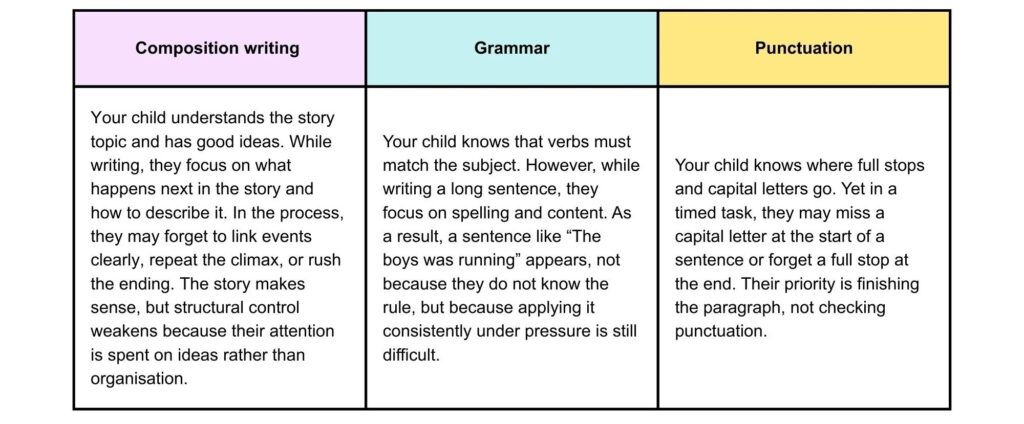
Why Rushing Makes Things Worse
When students rush, the brain has to handle too many things at the same time. This makes it harder to work carefully, even if they understand the topic.
In school, rushing often happens because students are worried about finishing on time or afraid of being left behind. When this happens:
-
- Students skim the question instead of reading it properly
-
- They answer based on what they remember, not what the question is really asking
-
- They forget to check whether the answer actually fits the question
This is very common in English, especially in comprehension and composition writing. Students may have good ideas, but rushing causes them to miss details, skip planning, or rush the ending.
For P5 to P6 students, this can be especially frustrating. Students know they can do better, but under exam pressure, the answer does not always reflect what they know. This does not mean they are weak though.
The problem is rarely that students don’t understand. Most of the time, it is simply that they are moving too fast for their thinking to stay clear and organised.
Slowing down, even slightly, helps the brain reconnect ideas, check details, and show a student’s real ability on paper.
Why Children Find It Hard to Control Carelessness
Most children are not careless on purpose. The truth is, checking their own work does not come naturally yet.
When children are doing schoolwork, they are usually focused on finishing. They are not used to stopping to ask themselves, “Did I read this properly?” or “Did I make a mistake here?” Pausing, checking, and reviewing are habits that need to be taught and practised.
Without guidance, children often do not notice their mistakes until an adult points them out. That is why repeatedly telling a child to “be more careful” rarely helps. They may want to do better, but they do not know how to be careful.
Carefulness is not about personality or attitude. It is a skill. Like reading or writing, it needs time, practice, and clear guidance to develop.
Carefulness is not something children are born with. It is a skill that grows with guidance, practice, and encouragement.
When parents and teachers:
-
- slow the process
-
- focus on one habit at a time
-
- teach checking clearly
-
- praise the right effort,
children learn to manage their thinking better, and their work starts to reflect what they truly know.
Here is how you can help as a parent
1. Slow the process, not the child
At P1 to P2, children rush because they are excited to finish, not because they want to be careless. They often do not know where to slow down.
What helps:
-
- Break the task into very clear steps
-
- Say each step out loud before they start
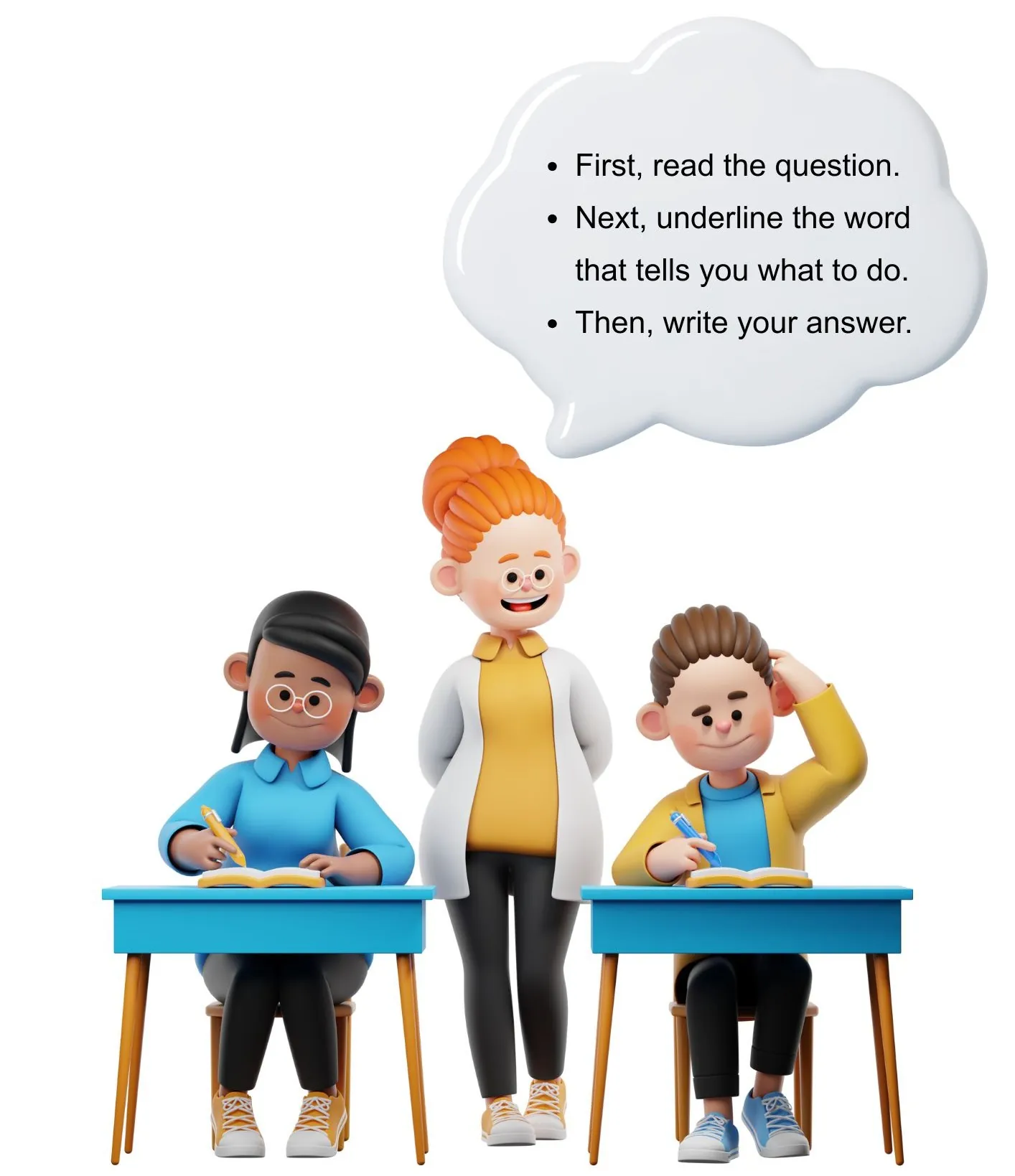
At this age, slowing the process helps the child feel calmer and more confident. When the steps are clear, their brain is less overwhelmed and mistakes reduce naturally.
2. Focus on one habit at a time
By P3, children are handling longer sentences and more detailed questions. Trying to fix everything at once often leads to frustration.
What helps:
-
- Choose one habit to work on for the week
For example:
-
- This week, focus only on full stops and capital letters.
-
- Next week, focus on answering all parts of the question.
When children know exactly what to focus on, they improve faster. Small wins build interest in learning, and reduce careless mistakes over time.
3. Teach checking as part of the work
At P4, children often stop once the answer is written. They think checking is optional or only for weak students.
What helps:
-
- Treat checking as the final step, not an extra task
For example, teach your child to always ask:
-
- Did I answer the question?
-
- Did I miss any words?
-
- Does this sentence make sense?
With practice, checking becomes automatic. Children begin to catch their own mistakes instead of relying on adults to point them out.
4. Praise effort in the right places
At P5 to P6, children are under more exam pressure. They already know they should be careful, but stress often causes them to rush.
What helps:
-
- Praise process, not just marks
For example:
-
- I noticed you slowed down and planned before writing.
-
- Good job checking your answers even when time was tight.
This teaches older students that careful habits matter more than speed. When effort and self-control are recognised, confidence improves and careless mistakes decrease.
When children learn how to slow down, check, and improve, careless mistakes reduce naturally. They gain confidence because they feel more in control of their work, not because they are being constantly reminded or corrected.
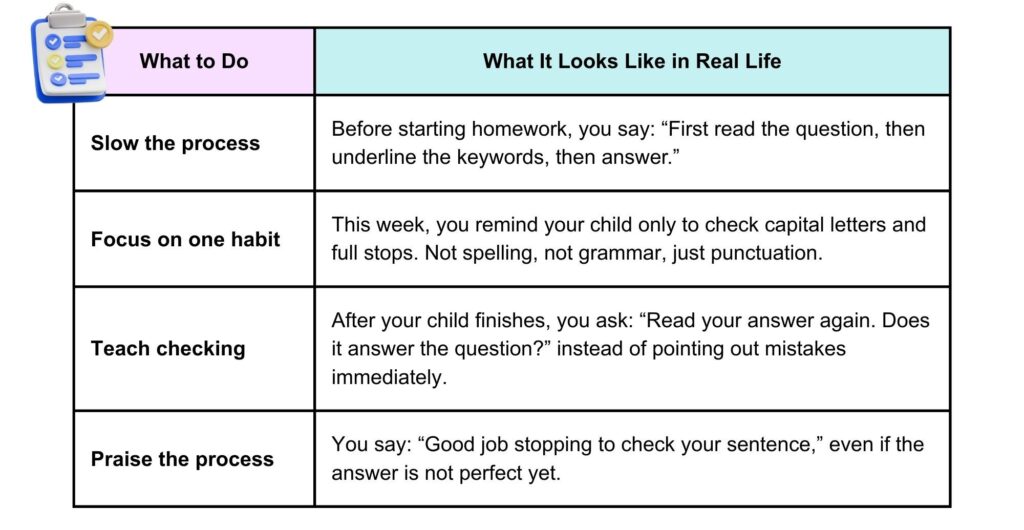
What Improvement Really Looks Like
When children learn to slow down and work step by step, careless mistakes start to reduce. Accuracy improves not because they “try harder”, but because they know what to check and how to check it.
This change does not happen overnight. It takes time because children are still developing the ability to manage their thinking while working under pressure. That is normal.
This matters because in upper primary, especially in exams like the PSLE, many students miss AL1 not because they lack ability, but because of small, avoidable mistakes. These small errors add up and pull a script down to AL2, even when the ideas and language are strong.
Across Primary school English teaching, the same pattern appears: students understand concepts but struggle to apply them consistently under time pressure. Research in cognitive psychology shows that when working memory is overloaded, children tend to fall back on familiar habits, even when those habits are ineffective.
Download our special guide to support your child in learning how to slow down, plan deliberately, and work with greater control, so their performance reflects what they truly understand.