Starbright
Creative Writing
(Pri 3 to Pri 6)
For Primary 3 to 6 Students | Creative Writing | MOE-aligned


For Primary 3 to 6 Students | Creative Writing | MOE-aligned
The Starbright programme for P3 to P6 provides progressive training aimed at deepening a child’s understanding of writing mechanics.
Students can benefit from:
1. Higher scores in school
2. Building a DSA Portfolio
3. Acquiring skills for DSA Essays
4. Improving chances of winning at writing competitions
5. Gaining confidence and interest in writing
We teach students essential writing skills: plot planning, character development, conflict escalation, “Show, Not Tell” and the use of figurative language and imagery to enhance language skills. The list goes on.
Starbright focuses on transforming students into more meticulous and creative writers. It emphasises holistic writing concepts, is theme-based and is result-driven.
All lessons run in a modular format, organised around specific themes. Each lesson comes with 3 segments:
One mock test per month for assessing progress, with grading and detailed feedback.
Corrections or a second draft is expected based on given feedback.
Your child will get to explore their own ideas freely but also learn how to make every paragraph count. Only teachers with strong creative writing teaching experience will train your child.
Transform your child’s writing, learn to write with purpose. On the average, our students will see gradual progress in their results in 6 to 9 months.
Your child will be exposed to an exciting range of story archetypes and as a result, enhance their abilities to create a variety plots that stand out. Afterall, you want to be prepared for surprises at the PSLE!
If you do the Math, your child will be exposed to 40 topics a year — that is 4 X 40 = 160 topics available in our Starbright programme!
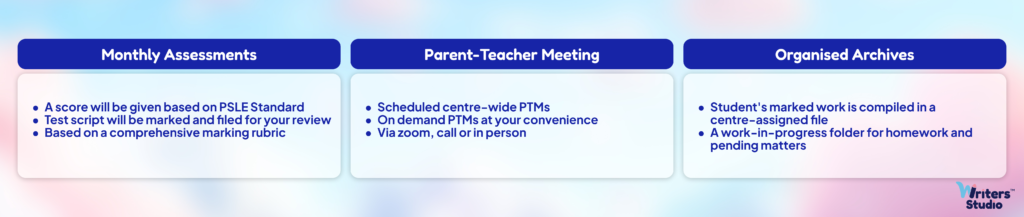
Parents will be able to assess their child’s progress through detailed marking by experienced teachers and periodic graded assessments.
STARBRIGHT is the culmination of years of experience from teachers with authentic writing backgrounds.
“For many students, the transition from the early primary years to formal composition writing can be challenging. Having been encouraged to write freely and creatively in the lower levels, they may find it discouraging when their writing is suddenly graded or judged by exam rubrics.
In the middle years, our lessons aim to preserve students’ enjoyment of writing while guiding them to understand what makes a composition effective when they are asked to in school. We continue to nurture creativity but also introduce structure and focus, through helping students recognise that strong writing is not about dramatic plots or “Hollywood-style” stories, but about clear expression and thoughtful focus.”

“As students enter the upper primary levels, they are expected to demonstrate greater linguistic precision and emotional maturity in their writing. The assessment rubrics also become more differentiated, requiring students to show nuanced understanding of content, organisation and language.
Our upper-year curriculum builds on skills developed in earlier stages while introducing techniques for deeper narrative development and emotional resonance. Students learn to refine the writer’s voice, create more layered characters and structure their stories in ways that engage and move the reader. This helps to prepare them not only for the PSLE English Paper 1 but also for longer-term success in secondary school writing.”
1. About Our Classes
Each lesson runs for 2 hours. The first 45 minutes focuses on pre-writing activities such as:
After a short break, students spend about 10 minutes planning their story outline and the second hour on their writing task. Most weeks, they complete a full-length composition within 50 minutes, mirroring PSLE English Paper 1 exam conditions.
Students should bring the following for every lesson:
Bringing these materials helps lessons run smoothly and encourages students to take responsibility for their learning.
Our classes are typically capped at six to eight students, allowing our teachers to provide focused attention and personalised feedback during writing and review time.
2. Curriculum and Learning Approach
While school lessons often emphasise exam results, our creative writing course explores the why and how behind effective storytelling. Techniques such as “Show, Not Tell” and narrative flow are taught in greater depth than most mainstream primary schools, helping students become confident and expressive writers.
This approach bridges creative writing and PSLE English preparation, equipping students to handle composition topics with both structure and insight.
Teachers provide written feedback and encourage corrections on all written work. Entire Draft 2s may be required as part of the lesson focus. Teachers may also request additional revisions for selected students, depending on learning needs.
Lesson materials include creative topical phrases for all themes, arranged by term and are further broken down into each academic week. Homework varies for each child as it is customised for intentional revision. This includes rewriting compositions, completing corrections, rewriting marked compositions and journaling creative phrases.
3. Assessment and Progress
Once a month, one lesson is designated as an assessment week, during which students’ compositions are graded with an expanded rubric aligned with the PSLE grading approach. This provides a clear view of their current standing and areas for growth.
Feedback is provided through written marking, in-class discussions, and weekly updates on the class’s Google Classroom page. Parents receive access upon registration.
Every term, parent-teacher meetings are held to report on student progress or concerns. Should parents be unable to attend, they are welcome to request individual updates at term intervals or whenever clarification is needed.
4. Attendance and Logistics
All classes across our education centre move at the same pace weekly. If your child is unable to attend a class, they must attend a makeup lesson in the same week to stay aligned with the ongoing curriculum.
For extended absences, makeups can be arranged in a different programme so your child continues learning new content without repetition.
Filing is an essential part of our primary school English tuition structure. Teachers conduct file checks to ensure students’ work is organised and complete. Parents are encouraged to review the ring file periodically as it serves as a tangible record of your child’s writing progress and consistency.
New files can be requested each term. If you or your child are unsure about what to file, please check with the teacher directly.
5. Additional Information
Our Starbright Programme develops both creativity and writing structure, ensuring our students are well-prepared for the PSLE English Paper 1 and beyond. By the upper primary levels, students learn to demonstrate linguistic precision and emotional maturity, which are skills that directly contribute to a lower PSLE AL score and smoother transition to the grading system in secondary schools.
Our lessons are taught by ex-MOE teachers and MOE-trained English teachers with experience in PSLE English preparation, ensuring that students are supported by educators who understand exam requirements and language development holistically. The programme is designed by ex-MOE teachers who held leadership positions in MOE schools and are familiar with the PSLE Paper 1 expectations.
The teachers have been very encouraging and attentive to the students’ needs. My child enjoys the lessons and has become more comfortable expressing his ideas in both writing and speech.
We are grateful for the support and guidance provided throughout his learning journey.
~ Mrs Winnie Ong