11 June 2026
Why Does My Child Attend English Tuition Yet Show Little Improvement?
Every year, new parents come to us with the same concern. Their children attend English tuition regularly, complete their school homework faithfully and appear to understand what is taught in class. Yet when examination papers are returned, the improvement often seems slower than expected. Naturally, this leads to frustration and uncertainty. If effort is being put in, why are the results not moving as quickly as hoped?
One of the biggest misconceptions about English is that improvement comes from completing more worksheets, memorising more model compositions or attempting more examination papers. While these resources certainly have value, they are rarely the reason students make significant progress. In reality, English is not simply a knowledge subject. It is a performance subject. A child may understand a technique perfectly during a lesson but still struggle to apply it independently during an examination.
Over the years, we have found that many students are not held back by a lack of intelligence. More often than not, they face a gap between knowing and doing. The challenge lies not in recognising a good answer, but in producing one under pressure. The ability to understand a concept and the ability to apply it effectively are often two very different things.
One of our Primary 5 students, Isaiah Huang, illustrates this challenge well. During discussions, Isaiah was thoughtful and engaged. Ideas came naturally to him and he could often explain what was happening in a story. However, once he began writing, those ideas seemed much harder to be written on paper. Although he knew the sequence of events, he struggled to elaborate on them. Feelings were briefly mentioned but not explored. Actions were described, yet the reasons behind them remained unclear. As a result, his compositions were shorter than expected and lacked the depth required at his level. He often gave up before the time was up. The issue was not creativity. Rather, he needed guidance in turning simple ideas into richer, more developed writing.
A different challenge emerged in another Primary 5 student, Chen Li’er. Her writing was generally accurate and her story structures were largely sound. Unlike Isaiah, her concern was not about generating ideas. Instead, she wanted to know how to make her compositions score. Questions about suspense, tension and reader interest frequently surfaced during discussions. She wanted to understand how good students in her school created anticipation, how emotions could be woven naturally into a story and how a composition could become memorable rather than merely correct – and hence score in school. For students like Li’er, improvement is often less about correcting weaknesses and more about refining existing strengths.
The demands become even greater as students move into secondary school. Secondary 1 student Winifred Koh demonstrated a challenge that many older students encounter. Classroom discussions were rarely a problem. She was able to contribute ideas and respond thoughtfully to questions. However, secondary-level English increasingly requires students to organise their thoughts precisely, justify their opinions and develop deeper analysis in her personal recounts in school. The transition from primary school to secondary school often reveals gaps that were not previously obvious. Strong ideas alone are no longer enough. Students must learn how to communicate those ideas clearly, logically and persuasively.
Looking across these different students, a common pattern emerges. Each student possesses the potential to perform well. Each student understands at least part of what is required. Yet the challenge lies in applying those skills consistently. Knowing what a climax is does not automatically mean a student can create one effectively. Understanding a comprehension technique does not guarantee that it will be applied accurately during an examination. Likewise, recognising a strong oral response is very different from producing one confidently under examination conditions.
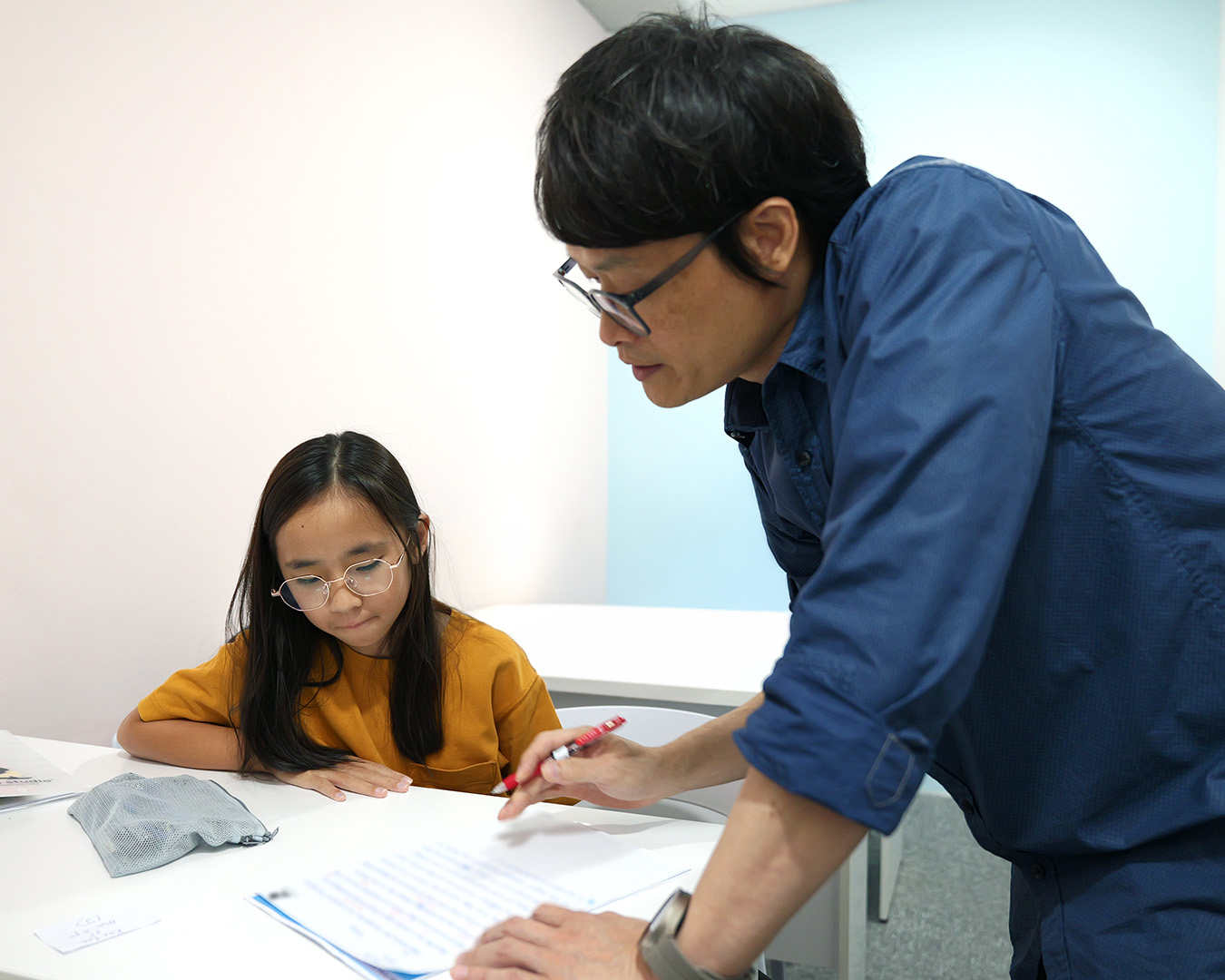
This understanding shapes the way we teach at Writers Studio. Rather than focusing solely on content delivery, we place significant emphasis on helping students understand the thinking process behind successful performance. Composition lessons focus not only on writing, but also on planning, idea generation and elaboration. Comprehension lessons go beyond identifying answers and teach students how to analyse question requirements and support their responses with evidence. Oral lessons focus on helping students organise their thoughts and communicate them confidently. Over time, these skills become habits that students can apply independently.
Equally important is what happens after the lesson ends. Learning is rarely a straight line. Concepts need reinforcement. Mistakes need correction. Skills need repeated application before they become natural. For this reason, meaningful feedback and follow-through remain important parts of our teaching philosophy. A student who struggles with elaboration requires different support from a student who struggles with vocabulary. Similarly, a student who lacks confidence in Oral communication requires a different intervention from one who struggles with comprehension. By identifying these patterns early, teachers can provide more targeted guidance and support.
Parents often search for the secret behind strong PSLE English results. In reality, there is rarely a single breakthrough moment. Improvement is usually built through hundreds of small victories. A student learns how to expand a paragraph properly. Another gains the confidence to speak during an oral discussion. Someone else finally understands how to organise a composition before writing. Although these moments may appear small individually, together they form the foundation of long-term improvement.
Ultimately, strong English results are not determined by how many phrases a student memorises or how many worksheets are completed. Far more important is the ability to think, apply and adapt independently. When effective teaching is combined with purposeful practice, meaningful feedback and consistent follow-through, students gradually develop the confidence and competence required to perform at their best.
Progress rarely happens overnight. Nevertheless, it is through these steady and often unseen improvements that meaningful PSLE English and Secondary English results are achieved. At Writers Studio, helping students make those improvements remains at the heart of what we do.