

11 February 2026
How the Letter C Changes Its Sound: Why Children Must Master Pronunciation
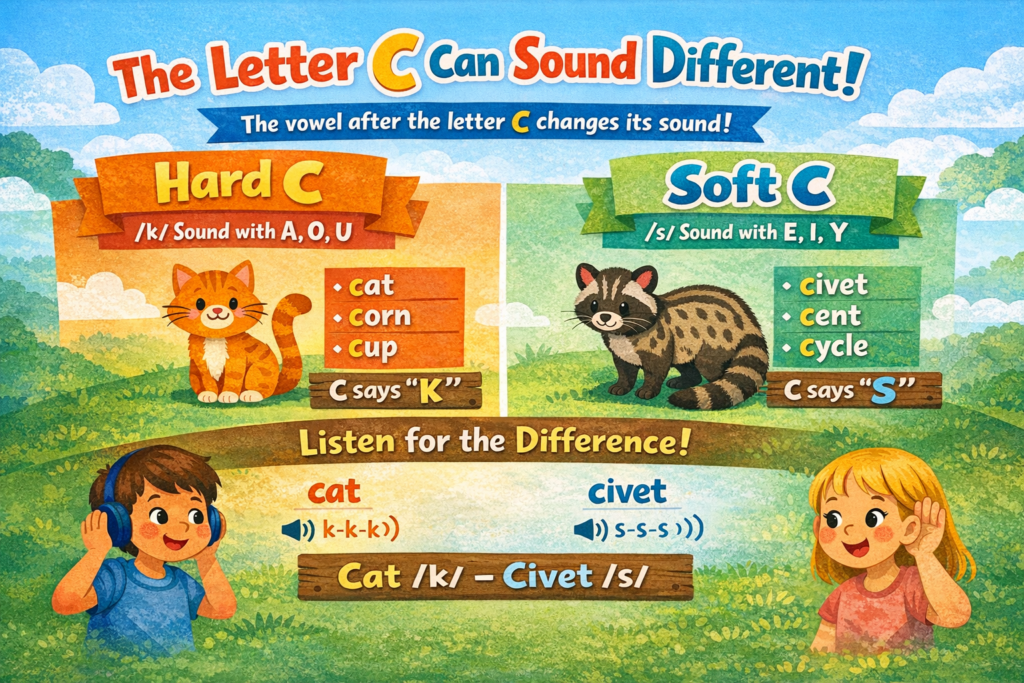
Is it a civet or a cat? The word “Cat” starts with a /k/ sound, while the word “civet” starts with a /s/ sound. If both words start with “C”, why do they not sound the same? This is a very common and completely normal question, especially among children in the early primary years. For young readers, it can seem as though the letter “C” is changing its mind from word to word, but in fact, its sound follows a consistent pattern, one that you can explain clearly without turning reading into a memorisation exercise.
In English, letters do not always come with just one fixed sound. They are flexible, and their pronunciation often depends on the letters that follow them. This can feel surprising to young children, who are taught early on that letters “say” certain sounds. The letter C is a good example of this flexibility. Rather than acting on its own, C pays attention to its neighbours. A helpful way to clarify such a confusion is to say that the letter C listens to the letters next to it, and adjusts its sound to fit the word accordingly.
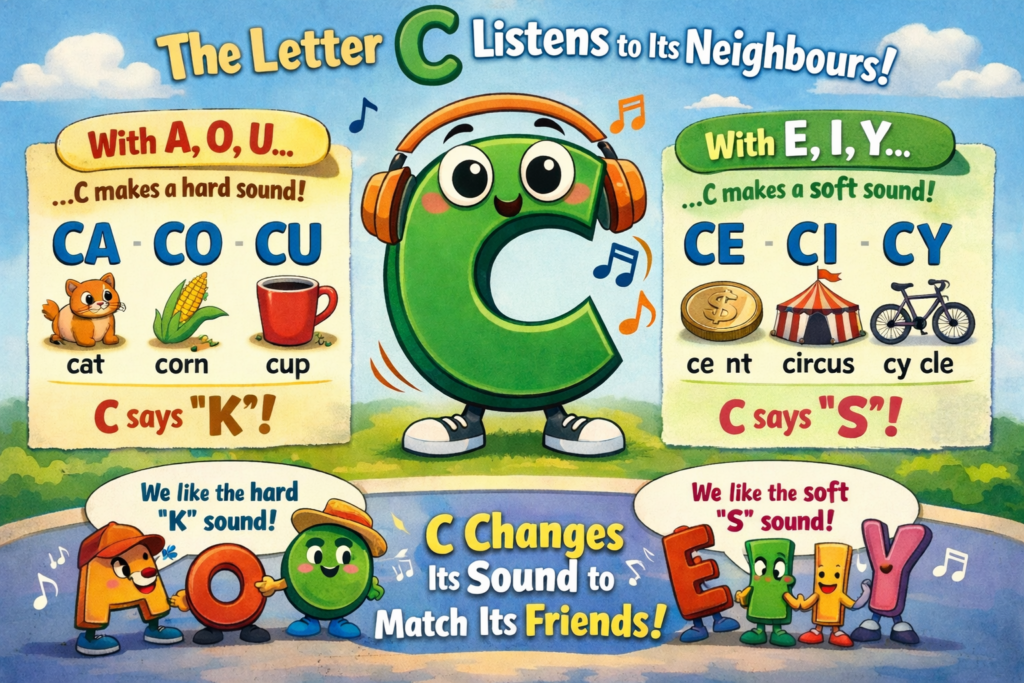
When the letter C in the word is often followed by vowels a, o or u, it usually would then make a hard /k/ sound, as in cat, cot or cup. However, when C comes before e, i or y, it will make a soft /s/ sound instead, just like in civet, city or cent. The key idea for children to grasp such a confusing concept is simple and reassuring: the letter after the C will give a hint at how it should be read. Once such a pattern is understood, children will stop thinking that the change in sound is random and start to find it predictable.
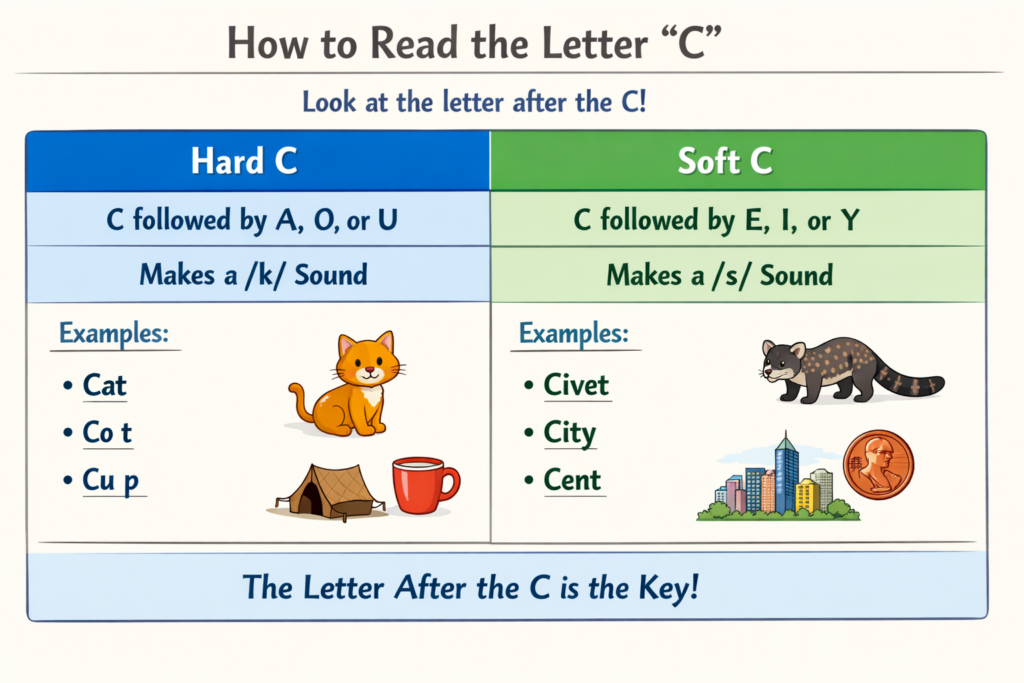
Children will now know that the letter C can make different sounds because the vowel that comes after it determines how it is pronounced. You may hear this described as the hard C (the /k/ sound) and the soft C (the /s/ sound), but what matters more for children is not the label but the sound shift itself. Children need to hear the difference before they can reliably read or spell it. When they can hear and thus understand why cat sounds different from civet, the rule begins to feel natural rather than forced.
This rule will also help children to learn that C is one of the most flexible letters in English. In some words, its sound is shaped by the surrounding letters, though this is a less common phenomenon. For example, special has a /sh/ sound, accept would sound like /ks/, and cue begins with a /ky/ sound. However, you do not need to be in a rush to make your children grasp all this knowledge. Rather, the purpose is simply to show that English spelling reflects layers of sound patterns and history, not randomness or inconsistency.
It is essential for us to know that such understanding of word pronunciation becomes especially important by around ages seven to eight. At this stage, children are expected to read fluently without sounding out every word, spell unfamiliar words using logic rather than guesswork, and recognise sound patterns automatically. When a child does not understand how the letter C works, reading can slow down, spelling can become uncertain, and confidence may begin to drop, which often affects comprehension as well. This is not an advanced rule but a foundation skill that supports everything that follows.
Strong English teaching focuses on sound awareness rather than rote learning. Instead of memorising long lists of rules, children are guided to listen for patterns, compare words like cat and civet, and predict how a new word should sound. When parents understand this approach, they can reinforce it naturally at home by talking about sounds, and not merely drilling spelling.
Most importantly, parents should be reassured that confusion is part of the learning process. Sound shifts are learnable, and with clear guidance, children do become confident, fluent readers. When children understand why letters change their sound, English stops being confusing and starts making sense.
Download a pronunciation guide and spelling list for perfecting the C sound here.
Byline:
Written by Teacher Claire, an advocate for strong pronunciation foundations and confident early readers